In Starsim, a product represents the actual medical tool that an intervention delivers: a diagnostic test, a treatment, or a vaccine. The split between interventions and products mirrors how real programs work: an intervention decides who gets something and when (eligibility, coverage, timing), while the product defines what happens to an agent when it’s administered.
This separation means you can reuse the same product across different delivery strategies. For example, a single vaccine product can be deployed via a routine immunization program in one scenario and a one-off campaign in another, without redefining the vaccine itself.
For how products are delivered, see the Interventions page; this page focuses on the products themselves.
Product types
All products inherit from ss.Product (itself an ss.Module) and implement an administer() method. Starsim provides three base product types:
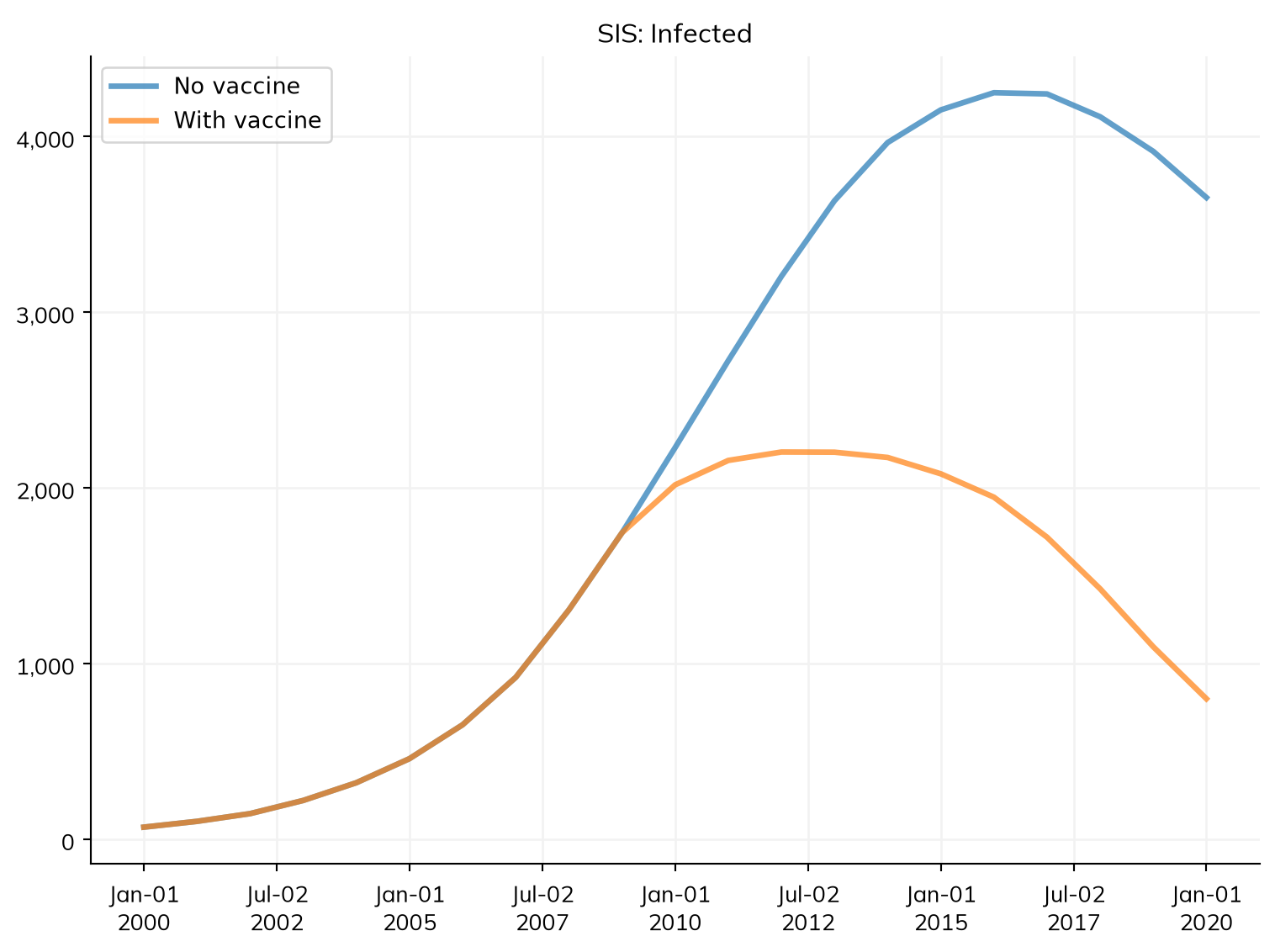
The simplest product to use is ss.simple_vx, a built-in vaccine that reduces an agent’s relative susceptibility (rel_sus). It can be “leaky” (everyone who is vaccinated gets partial protection, the default) or “all-or-nothing” (leaky=False, where a fraction of recipients are fully protected and the rest are not protected at all):
import starsim as ssss.options(jupyter=True)# Create a vaccine product with 80% efficacyvaccine = ss.simple_vx(efficacy=0.8)# Deliver it through a routine vaccination programvaccination = ss.routine_vx(product=vaccine, start_year=2010, prob=0.5)# Run with and without the vaccinepars =dict(n_agents=5000, start=2000, stop=2020, diseases='sis', networks='random', verbose=0)s1 = ss.Sim(pars, label='No vaccine')s2 = ss.Sim(pars, label='With vaccine', interventions=vaccination)ss.parallel(s1, s2).plot('sis_n_infected')
Figure(768x576)
Diagnostics
A diagnostic product (ss.Dx) is defined by a dataframe giving the probability of each test result, conditional on an agent’s true disease state. The results are returned in priority order (the hierarchy), with the first listed result taking precedence when an agent could match more than one:
import sciris as scimport starsim as ss# Probability of each result given the agent's true statedx_data = sc.dataframe( columns = ['disease', 'state', 'result', 'probability'], data = [ ['sis', 'susceptible', 'positive', 0.01], # False positive rate ['sis', 'susceptible', 'negative', 0.99], ['sis', 'infected', 'positive', 0.95], # Sensitivity ['sis', 'infected', 'negative', 0.05], ])# Create the diagnostic product and deliver it via screeningtest = ss.Dx(df=dx_data)screening = ss.routine_screening(product=test, prob=0.5, start_year=2010)sim = ss.Sim(n_agents=5000, start=2000, stop=2020, diseases='sis', networks='random', interventions=screening, verbose=0)sim.run()# The screening intervention records who tested positive/negative each stepprint('Tested positive on final step:', len(sim.interventions.routine_screening.outcomes['positive']))
Tested positive on final step: 1755
Screening is often paired with treatment: agents who test positive become eligible for a treatment intervention (this is the “triage” pattern; see the Interventions page).
Treatments
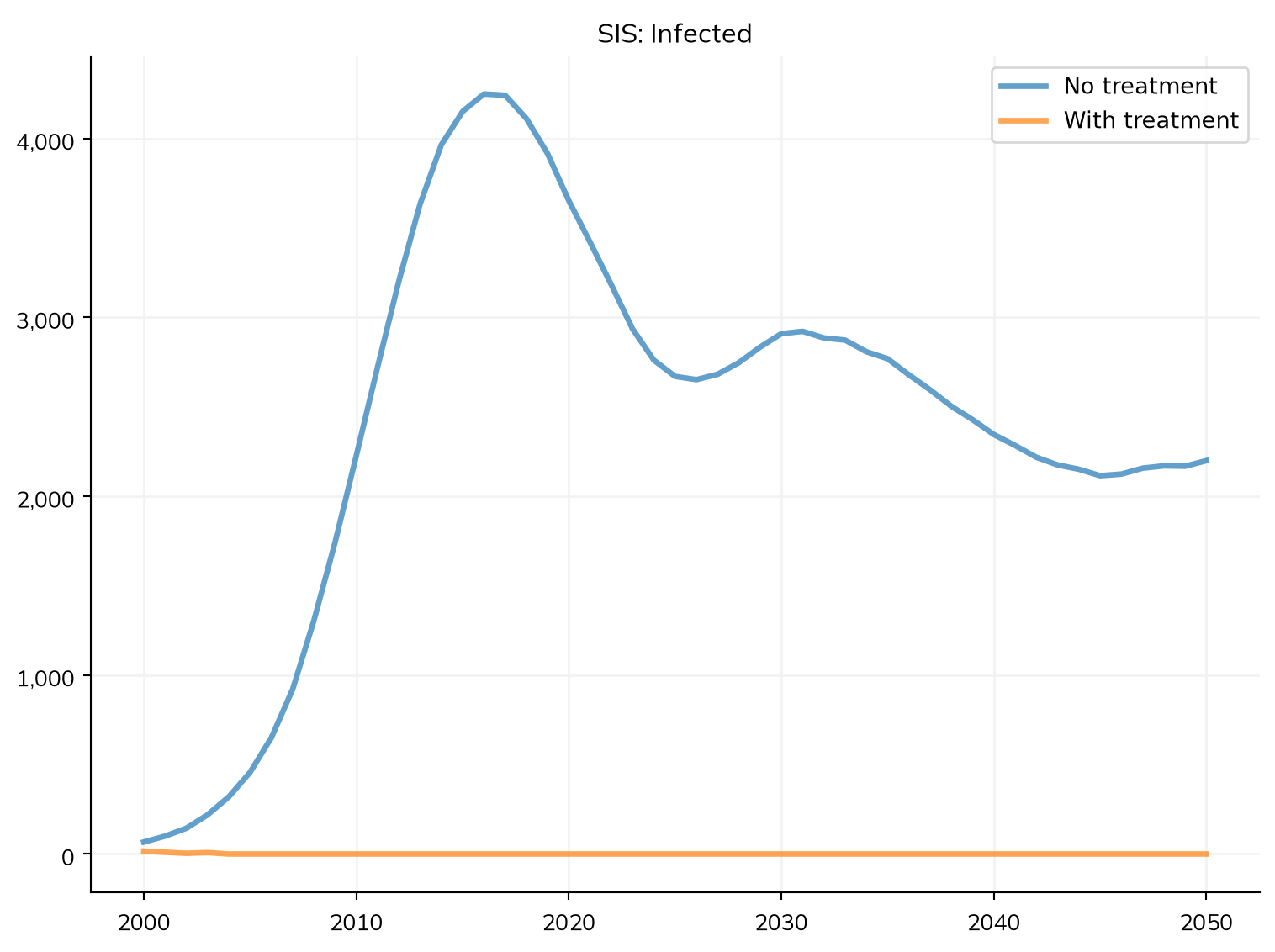
A treatment product (ss.Tx) moves agents from one disease state to another with a given efficacy. It’s defined by a dataframe with disease, state, post_state, and efficacy columns. Here we clear infection in an SIS model, returning treated agents to susceptible:
import sciris as scimport starsim as ss# Treatment clears infection with 80% efficacytx_data = sc.dataframe( columns = ['disease', 'state', 'post_state', 'efficacy'], data = [['sis', 'infected', 'susceptible', 0.8]],)treatment = ss.treat_num( product = ss.Tx(df=tx_data), eligibility =lambda sim: sim.diseases.sis.infected.uids, max_capacity =50, # Treat at most 50 agents per timestep)pars =dict(n_agents=5000, diseases='sis', networks='random', verbose=0)s1 = ss.Sim(pars, label='No treatment')s2 = ss.Sim(pars, label='With treatment', interventions=treatment)ss.parallel(s1, s2).plot('sis_n_infected')
Figure(768x576)
The max_capacity argument caps how many agents can be treated per timestep, which is useful for modelling resource-constrained programs.
Writing a custom product
If the built-in products don’t do what you need, you can write your own by subclassing ss.Vx, ss.Dx, ss.Tx, or ss.Product directly and implementing administer(). Vaccine products receive (people, uids); diagnostics and treatments receive (uids) and return their outcomes.
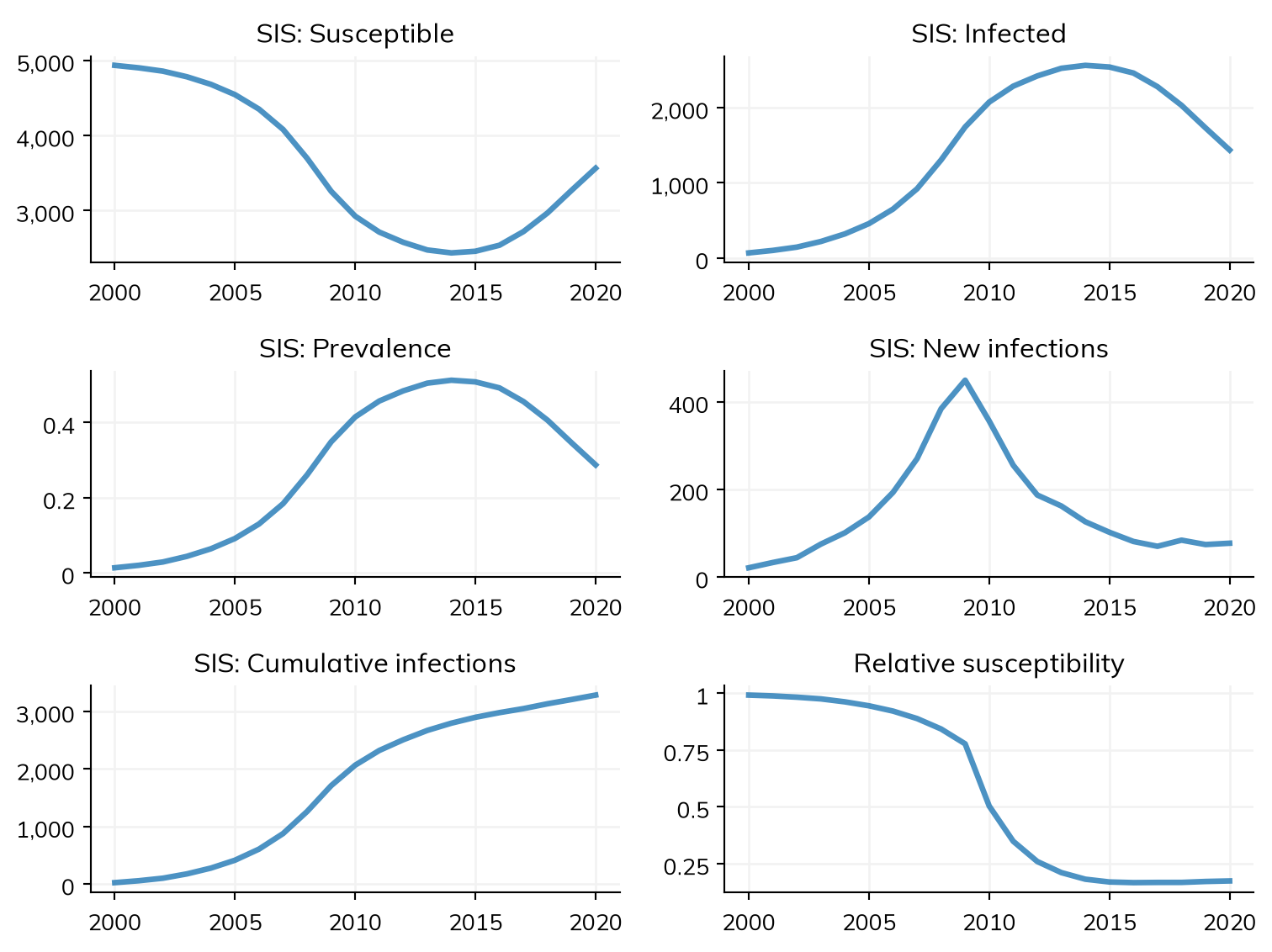
The example below is a vaccine whose efficacy is higher for younger agents:
import starsim as ssimport numpy as npclass AgeTargetedVx(ss.Vx):""" A vaccine that is more effective in younger agents """def__init__(self, efficacy=0.9, **kwargs):super().__init__()self.define_pars(efficacy=efficacy)self.update_pars(**kwargs)returndef administer(self, people, uids):# Efficacy declines linearly with age, to a floor of 0 age_factor = np.clip(1- people.age[uids]/80, 0, 1) protection =1-self.pars.efficacy*age_factorfor disease inself.sim.diseases.values(): disease.rel_sus[uids] *= protectionreturnvaccination = ss.routine_vx(product=AgeTargetedVx(efficacy=0.9), start_year=2010, prob=0.5)sim = ss.Sim(n_agents=5000, start=2000, stop=2020, diseases='sis', networks='random', interventions=vaccination, verbose=0)sim.run()sim.plot('sis')
Figure(768x576)
Tip
Because products are modules, they can define their own parameters (with define_pars()), states, and results, just like any other Starsim module. See Adding new modules for the general pattern.